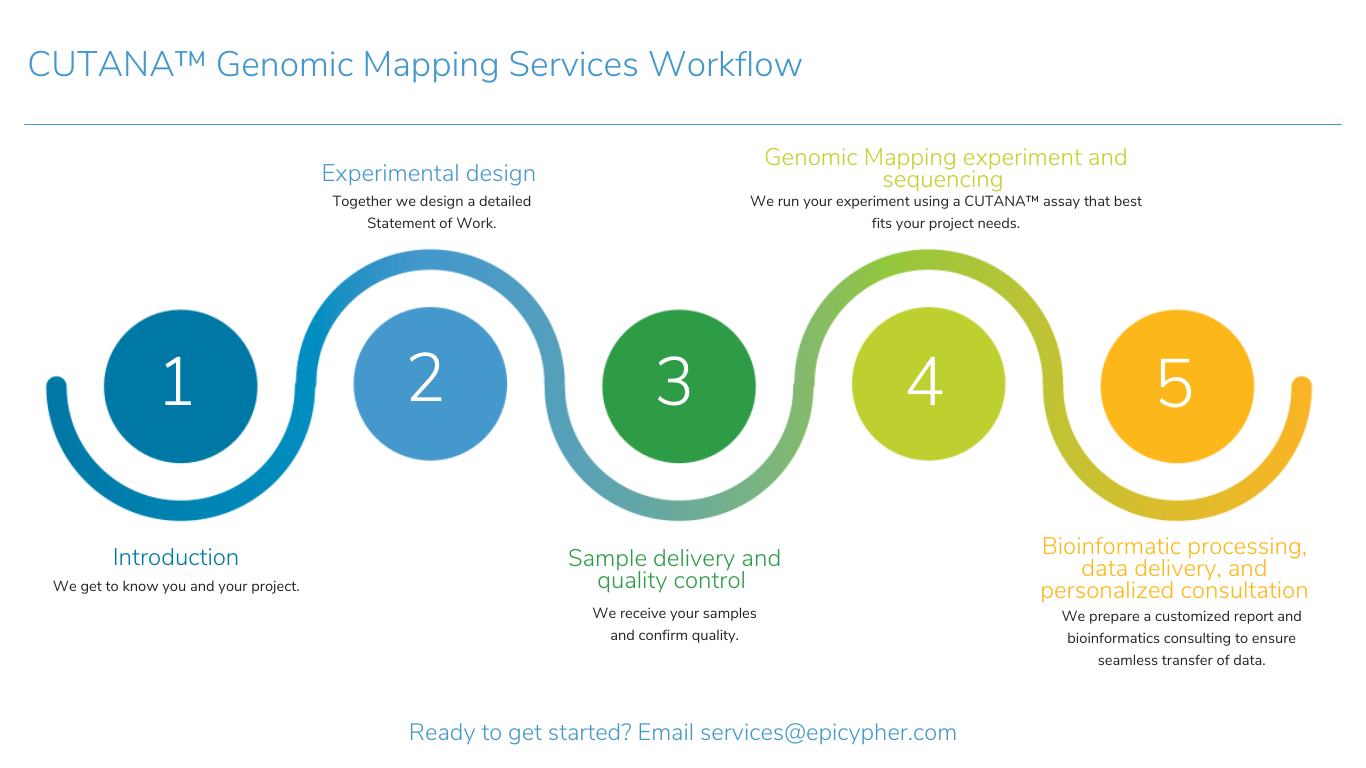

CUTANA™ Genomic Services
Gene Regulation Insights for Modern Drug Discovery
EpiCypher’s CUTANA™ Genomic Services provide a direct view into gene regulation, the “software” of the genome that determines how genetic information drives cell-type– and disease-specific gene expression programs. Because changes in gene activity ultimately drive drug response, gene regulatory insights are essential for understanding mechanism of action across diverse therapeutic strategies.
Our industry-validated CUTANA™ workflows deliver reproducible, genome-wide data that reveal how your compound influences this regulatory software in cells. With expert-led CUT&RUN, DNA Methylation, Fiber-seq, ATAC-seq, and FFPE Services, we link molecular intervention to downstream regulatory effects, enabling clearer interpretation of target biology, earlier detection of resistance, and more confident decision-making throughout drug discovery.
Deliver high-quality genomic data that strengthen MoA hypotheses, inform biomarker strategy, and accelerate programs from discovery through development.
As our partner, you can expect:
- Detailed, end-to-end experimental design
- Expert optimization for targets, cell types, tissues, and clinical samples
- Reliable profiling using automated assays and standardized controls
- A comprehensive data report and presentation by our scientists
- Scalable protocols from pilot tests to high-throughput studies
Have a Project in Mind?
We’re here to help. Tell us more about your experiment, and our Expert Services team would be thrilled to help you get started!
CUTANA™ Genomic Services

CUTANA™ CUT&RUN Services
CUT&RUN enables genome-wide mapping of chromatin targets, including transcription factors and epigenetic marks, revealing mechanistic insights beyond expression-based assays. Our automated workflows incorporate quantitative spike-in controls to deliver scalable, reproducible data with reliable cross-sample comparisons for translational and preclinical research.
Learn More ›

CUTANA™ Fiber-seq Assay Services for Long-Read Sequencing
Fiber-seq enables single-molecule, multiomic profiling of chromatin accessibility, protein occupancy, DNA methylation, and DNA sequence on the same molecule. Unlike conventional assays that measure these features separately, Fiber-seq captures their coordinated regulatory states, revealing mechanistic insights into chromatin heterogeneity, drug response, and resistance.
Learn More ›

CUTANA™ DNA Methylation Sequencing Services
Our DNA Methylation sequencing
technologies overcome the limitations
of destructive bisulfite-based
methods. By preserving native DNA
and enabling multiomic profiling
alongside transcription factor binding
and chromatin features, EpiCypher’s
approaches link methylation to
function, delivering clearer mechanistic
insight into disease biology, drug
response, and biomarker strategy.
Learn More ›

CUTANA™ ATAC-seq Services
ATAC-seq maps chromatin
accessibility, revealing open
chromatin, transcription factor
occupancy, and nucleosome
positioning. Our validated workflow
delivers reproducible short-read
profiling from as few as 1,000 nuclei,
matching or exceeding leading
competitor assays, and complements
CUT&RUN, Fiber-seq, and DNA
Methylation services.
Learn More ›
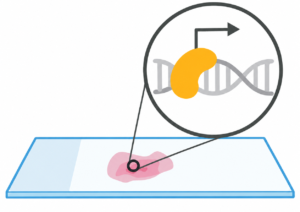
FFPE Transcription Profiling
FFPE Transcription Profiling unlocks transcriptomic insights from archival tissue without relying on RNA. Using a modified RNA Pol II CUT&Tag workflow on a single 5 µm FFPE section, our assay captures transcription-associated promoters and active enhancers, enabling biomarker discovery and new insight from retrospective cohorts.
Learn More ›

Featured Customers
Easy Onboarding - Expert Guidance - Timely Completion
Selected Publications
- Agustinus et al. Epigenetic dysregulation from chromosomal transit in micronuclei. Nature 619, 176-183 (2023). PMID: 37286593.
- Baysoy et al. The interweaved signatures of common-gamma-chain cytokines across immunologic lineages. Journal of Experimental Medicine 220 (2023). PMID: 36976164.
- Asberry et al. Reprogramming landscape highlighted by dynamic transcriptomes in therapy-induced neuroendocrine differentiation. Computational and Structural Biotechnology Journal 20, 5873-5885 (2022). PMID: 36382181.