
SKU: 15-1038, 15-1037
CUTANA™ SsDddA Inhibitor Protein, SsDddI

 Powered by Bioz
Products in EpiCypher’s IDEA Toolbox (Innovation and Discovery of Epigenetic Applications) offer access to reagents without known or fully defined uses, enabling researchers to explore cutting-edge applications. Due to their novelty and unexplored potential, EpiCypher will engage in limited technical support.
SsDddI is the cognate inhibitor of SsDddA, used to stop SsDddA deamination activity. SsDddA and SsDddI form a 1:1 complex. Therefore, inhibition is expected to occur at equimolar ratio. For rapid inhibition, SsDddI is used in a 5x molar excess to quench SsDddA deaminase activity in the Stergachis Lab DAF-seq Protocol available on Github [1].
Key Advantages
References:
[1] Stergachis Lab. The Guide for DAF-seq: Protocol. https://fiberseq.github.io/The-Guide-for-DAF-seq/protocol/protocol.html. Accessed 24 September 2026
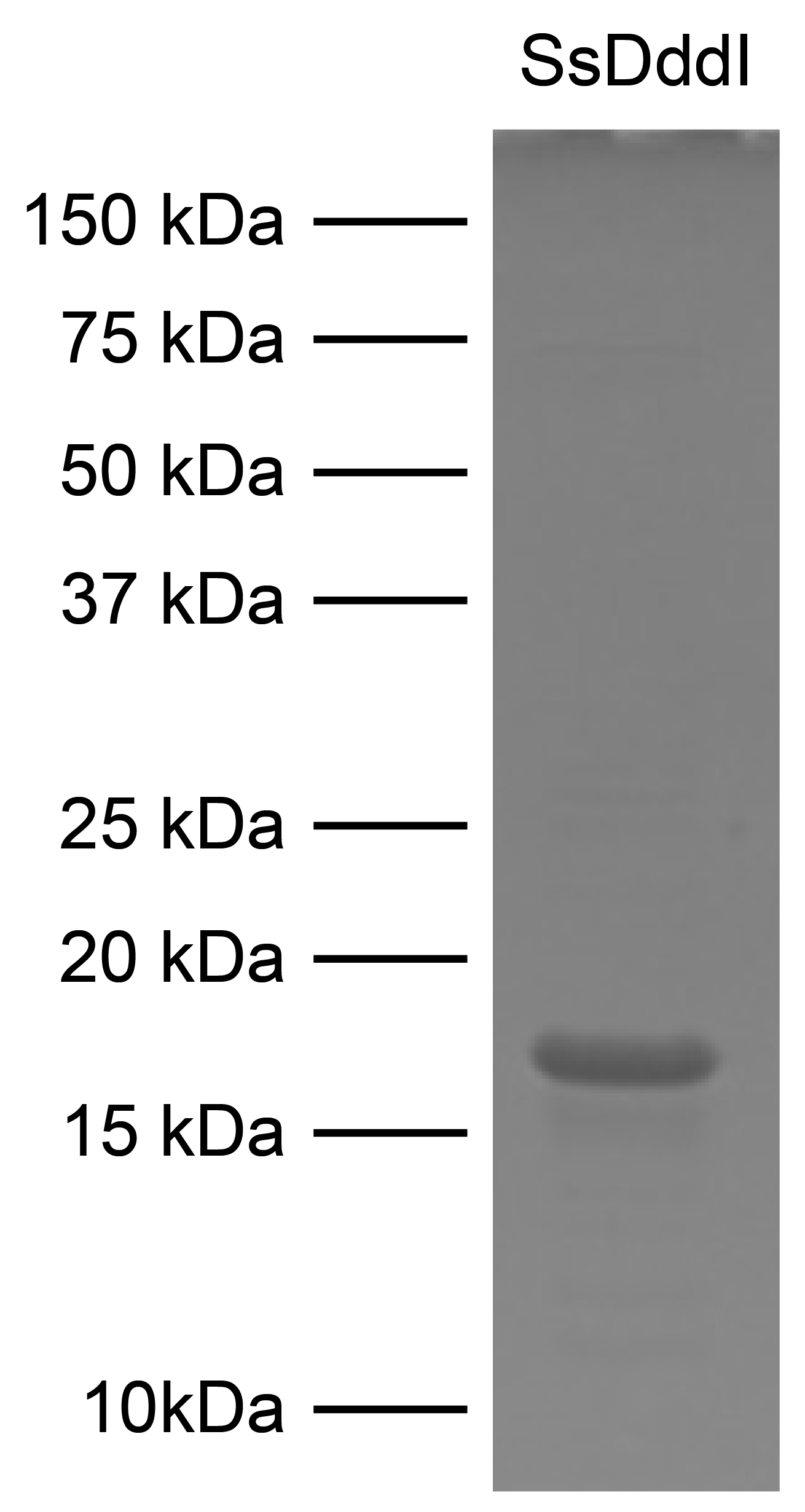
CUTANA SsDddI (2.5 µg) was resolved via SDS-PAGE and stained with Coomassie blue. Relative migration of protein size standards are indicated on the left.
Storage
Store at -20°C. Refer to product label for expiration date.
Formulation
50 mM Tris pH 7.8, 500 mM NaCl, 0.1 mM EDTA, 10 µM ZnCl2, 50% glycerol
| Item | Cat. No. |
|---|---|
| CUTANA SsDddA Deaminase | 15-1037 |
SsDddI is capable of quenching SsDddA in all SsDddA compatible buffers listed in the application notes on the SsDddA technical datasheet. Biologically, SsDddI and SsDddA form a 1:1 complex and therefore inhibition should be observed at a 1:1 molar ratio. To ensure rapid quenching of deaminase activity, users are encouraged to use a molar excess of SsDddI to SsDddA. The exact molar excess needed likely depends on the application and assay conditions. SsDddI is provided at a 10x concentration compared to SsDddA. Users wishing to add 5x molar excess SsDddI to SsDddA (as is instructed in the Stergachis Lab DAF-seq protocol) should use 1 µL of SsDddI for every 2 µL of SsDddA (15-1037).
Dr. Andrew Stergachis has validated EpiCypher CUTANA SsDddA and SsDddI in his DAF-seq protocol. Users wishing to use SsDddA and SsDddI in DAF-seq are encouraged to refer to the Stergachis Lab DAF-seq protocol page.
Users who have validated these reagents in other workflows and would like to share their results with the broader community are encouraged to reach out. We’d love to highlight how these tools are helping you innovate in your research.