
SKU: 15-1037, 15-1038
CUTANA™ SsDddA Deaminase

 Powered by Bioz

Products in EpiCypher’s IDEA Toolbox (Innovation and Discovery of Epigenetic Applications) offer access to reagents without known or fully defined uses, enabling researchers to explore cutting-edge applications. Due to their novelty and unexplored potential, EpiCypher will engage in limited technical support.
SsDddA is a double-stranded DNA (dsDNA) cytidine deaminase from the bacterial species Simiaoa sunii that converts accessible cytosine to uracil [1]. These uracil residues can then be detected as C-to-T mutations following PCR amplification and sequencing. SsDddA has been used to label chromatin accessibility in two recently published methods, DAF-seq [1] and ACCESS-ATAC [2].
Double-stranded DNA deaminases are key enabling enzymes in emerging deaminase-based chromatin accessibility mapping methods. In general, cytosines that are bound by proteins or wrapped within nucleosomes are protected from deamination. After sequencing, stretches of DNA without C-to-T mutations are inferred to be protein-occupied. Because the resulting C-to-T marks are non-destructive to DNA and are preserved through PCR amplification, these methods are compatible with both long-read and short-read sequencing. When paired with long-read sequencing, deaminase-mediated labeling enables chromatin accessibility mapping and protein footprinting from lower sample inputs than other long-read accessibility assays that are not PCR-compatible. When paired with short-read sequencing, deamination provides more precise protein footprinting than standard ATAC-seq. Users interested in learning more about deaminase-based methods are encouraged to consult a recent review by Krebs et al. describing deaminase-based single-molecule genomics methods [3].
Key Advantages
References:
[1] Swanson et al. Nat. Biotechnol. (2025). PMID: 41339527
[2] Yu et al. bioRxiv (2024). PMID: 39763859
[3] Krebs et al. Nat. Rev. Mol. Cell Biol. (2026). PMID: 42736336
[4] Stergachis Lab. The Guide for DAF-seq: Protocol. https://fiberseq.github.io/The-Guide-for-DAF-seq/protocol/protocol.html. Accessed 24 September 2026
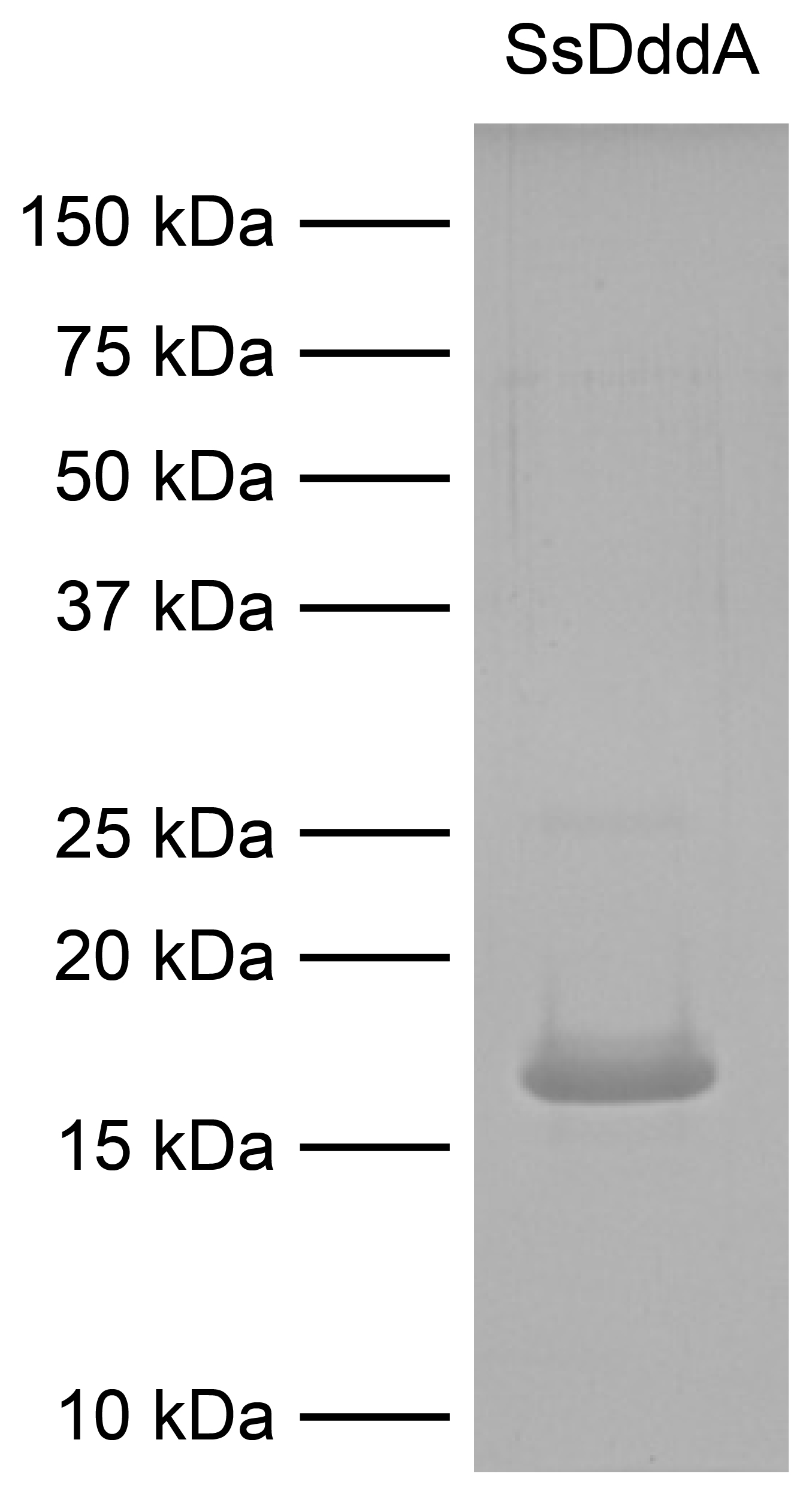
CUTANA SsDddA (2.5 µg) was resolved via SDS-PAGE and stained with Coomassie blue. Relative migration of protein size standards are indicated on the left.
Cytosine containing double-stranded DNA templates (263 bp) were incubated with (+) and without (-) CUTANA SsDddA, purified, and PCR amplified. Products were sequenced (Plasmidsaurus Premium PCR service) and IGV used to visualize ‘percent conversion’ at each base. Deamination of cytosine to uracil by SsDddA is recorded as C→T (or G→A on opposite strand) mutations during amplification. Teal and orange respectively indicate base conversion on the top or bottom strand.
Storage
Store at -20°C. Refer to product label for expiration date.
Formulation
50 mM Tris pH 7.8, 500 mM NaCl, 0.1 mM EDTA, 10 µM ZnCl2, 50% glycerol
| Item | Cat. No. |
|---|---|
| CUTANA SsDddA Inhibitor Protein, SsDddI | 15-1038 |
For use in general deamination reactions, EpiCypher has verified that SsDddA is compatible with the following buffer conditions. Users are encouraged to validate buffer compatibility with their desired application, as the ideal buffer may vary depending on application:
15 mM Tris pH 8.0, 15 mM NaCl, 60 mM KCl, 1 mM EDTA pH 8.0, 0.5 mM EGTA pH 8.0, 10 nM ZnCl2 (as reported in the Swanson et al. DAF-seq publication)
15 mM Tris pH 8.0, 15 mM NaCl, 60 mM KCl, 1 mM EDTA pH 8.0, 0.5 mM EGTA pH 8.0 (as reported in the Stergachis Lab DAF-seq protocol page)
Dr. Andrew Stergachis has validated EpiCypher CUTANA SsDddA and SsDddI in his DAF-seq protocol. Users wishing to use SsDddA and SsDddI in DAF-seq are encouraged to refer to the Stergachis Lab DAF-seq protocol page.
Users who have validated these reagents in other workflows and would like to share their results with the broader community are encouraged to reach out. We’d love to highlight how these tools are helping you innovate in your research.