CUT&RUN Decodes Drug Resistance Mechanisms
- Stuart P. Atkinson
Beyond RNA-seq: Applying CUT&RUN to Decode Drug Resistance and Inform Rational Combination Therapies
Key Takeaways:
- RNA-seq and ATAC-seq reveal transcriptional rewiring associated with cancer drug resistance; however, they only indirectly implicate the responsible transcription factors.
- CUT&RUN directly maps transcription factor binding on chromatin, decoding regulatory mechanisms of drug responses and informing rational combination therapies.
Why Chromatin Mapping Matters for Targeted Therapy Development in Cancer
Targeted therapies often trigger widespread transcriptional alterations as tumor cells adapt to treatment, but identifying the regulatory mechanisms that drive these responses remains a major challenge in cancer drug development. While RNA-seq and ATAC-seq can reveal shifts in gene expression and chromatin accessibility, they rarely identify the transcription factors driving those changes. This creates a mechanistic blind spot when researchers attempt to define how tumors respond to treatment or develop resistance.
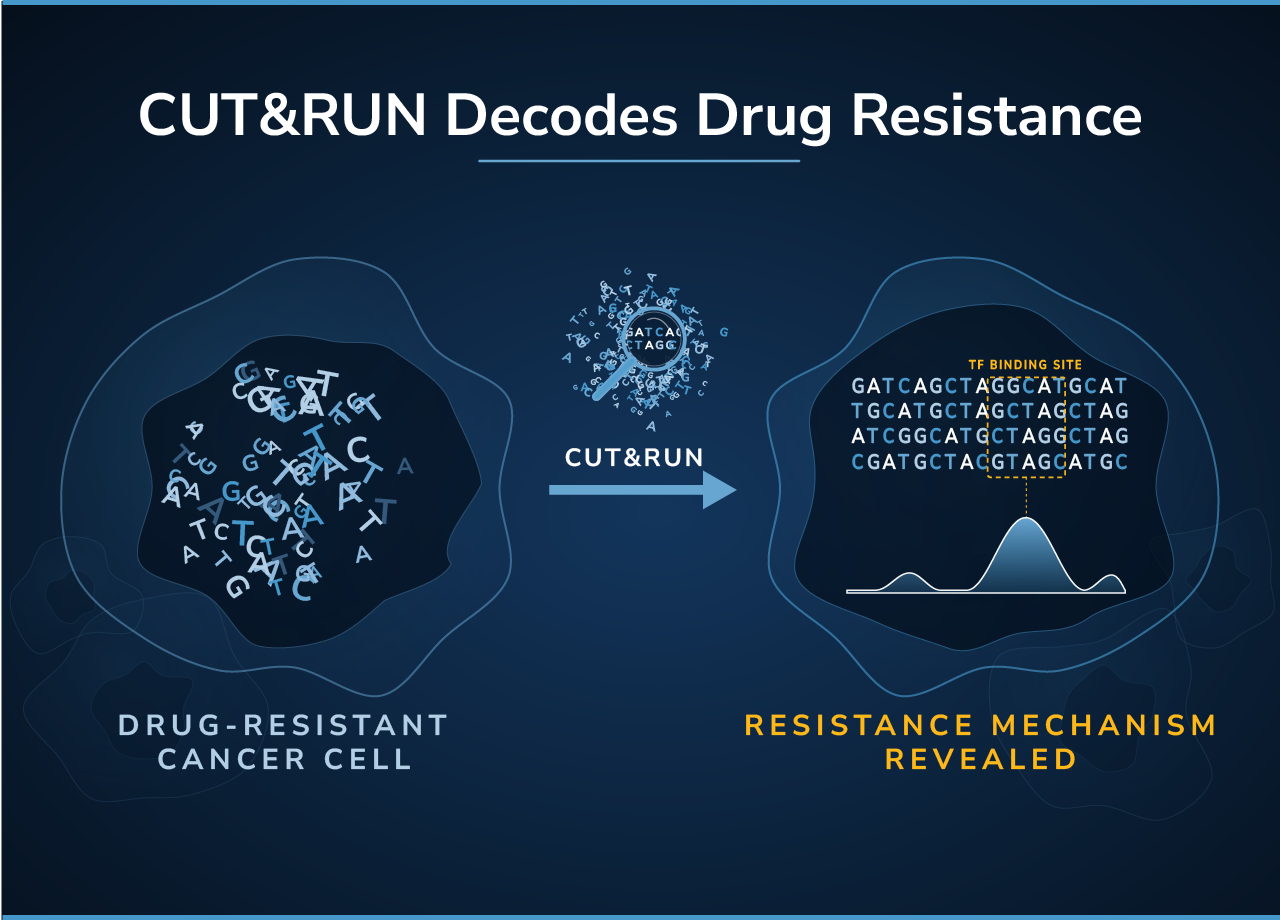
Moving beyond RNA-seq and ATAC-seq, CUT&RUN addresses this knowledge gap by directly mapping transcription factor binding across the genome. By measuring regulatory protein occupancy on chromatin in cancer cells, CUT&RUN has the power to directly link drug treatment to the transcriptional mechanisms that control downstream gene expression programs.
A recent study in Nature Communications by researchers at Genentech illustrated how CUT&RUN can “decode” mechanisms of resistance to targeted cancer therapies.1 They focused on the Hippo signaling pathway, a key regulator of cell proliferation and tissue growth. Disruption of Hippo signaling prompts the transcriptional co-activators YAP and TAZ to activate TEAD family transcription factors, which drive oncogenic gene expression programs. The frequent dysregulation of this pathway in cancers such as malignant mesothelioma has highlighted TEAD inhibitors as promising therapeutic candidates.
As resistance to targeted therapies often develops during prolonged treatment, understanding the transcriptional mechanisms that enable tumor cells to escape TEAD inhibition remains essential for guiding the rational development of more effective therapeutic strategies. To investigate these mechanisms, the team behind this study integrated multiomic profiling with chromatin mapping using CUTANA™ CUT&RUN, uncovering a transcriptional mechanism of resistance and identifying a combination treatment strategy capable of restoring drug sensitivity.
Importantly, this research highlighted how chromatin mapping can aid drug development, even for therapies that do not directly target classical epigenetic regulators. In this case, CUT&RUN helped uncover resistance driven by MAPK signaling, a key intracellular signal transduction pathway involved in cell proliferation and survival. Overall, this study highlights CUT&RUN as an exciting means of decoding drug resistance and informing the rational development of combination therapies in cancer.
Direct Mapping of Transcription Factor Binding Reveals a Resistance Mechanism
To identify regulatory changes associated with TEAD inhibitor resistance, researchers first compared chromatin accessibility between drug-sensitive and drug-resistant mesothelioma cells using ATAC-seq. Regions becoming more accessible in resistant cells displayed an enrichment for TEAD and AP-1 transcription factor motifs, suggesting altered transcription factor activity.
The AP-1 (Activator Protein-1) transcription factor complex constitutes a family of regulatory proteins that includes FOS and JUN. AP-1 factors are frequently activated downstream of signaling pathways such as MAPK and play major roles in regulating proliferation, stress responses, and tumor progression. Single-cell ATAC-seq and RNA-seq analyses further supported this observation, revealing the increased activity of FOSL1, another member of the AP-1 transcription factor family.
However, these approaches provided only indirect evidence of transcription factor engagement. Motif enrichment suggests potential binding, while RNA-seq captures transcriptional consequences that occur downstream of regulatory events. To directly map transcription factor occupancy on chromatin in drug-resistant cancer cells, the investigators turned to CUT&RUN.
Using CUT&RUN, the researchers profiled genome-wide binding of TEAD1, YAP, and FOSL1 in drug-sensitive and drug-resistant cancer cells, revealing increased recruitment of all three transcription factors to regulatory regions associated with therapeutic resistance. Using CRISPR-mediated FOSL1 knockout cells, CUT&RUN demonstrated that FOSL1 is required for YAP/TEAD recruitment to chromatin. Together, these results revealed a direct mechanistic link between signaling pathway activation and transcription factor binding in drug-resistant cancer cells.
Orthogonal Validation of Chromatin Changes Using ChIP-seq
The authors also generated ChIP-seq profiles for YAP and FOSL1, which closely matched the CUT&RUN results. Such concordance demonstrates that CUT&RUN robustly profiles transcription factor binding, addressing a common concern among researchers transitioning from traditional ChIP-based approaches. Importantly, CUT&RUN achieved this feat while profiling protein-DNA interactions directly in native chromatin using a simplified in situ workflow, all while producing higher signal-to-noise with far lower input requirements than ChIP-seq.
For drug development teams, these advantages of CUT&RUN translate into several enabling capabilities:
- The ability to generate mechanistic insights from limited samples (including primary cells, xenografts, or precious patient samples).
- More robust identification of transcriptional mechanisms driving drug response or therapeutic resistance.
- Assay automation for standardized, high throughput studies.
These capabilities are particularly valuable for directly verifying adaptive transcriptional programs that emerge during targeted cancer therapy, and support the emergence of CUT&RUN as the new gold standard approach for chromatin mapping.
Chromatin Profiling Guides Rational Combination Therapy
Integrated pathway analysis of the multiomic data implicated MAPK signaling, a known upstream activator of AP-1 transcription factors. These findings suggested that MAPK-driven activation of FOSL1 enables resistant cells to recruit YAP/TEAD back to chromatin, restoring oncogenic transcriptional programs despite TEAD inhibition and creating a MAPK-dependent escape mechanism.
These insights had immediate therapeutic implications, suggesting that MAPK inhibition could potentially restore sensitivity to TEAD inhibitors. Indeed, MAPK inhibition resensitized resistant cancer cells to TEAD-targeted therapy and improved tumor control in a mouse mesothelioma xenograft model. These findings highlighted the value of chromatin profiling in cancer drug development. By directly measuring transcription factor binding, CUT&RUN can reveal how regulatory networks change during drug treatment and identify signaling pathways that drive therapeutic escape.
Accelerating Mechanism-of-Action Studies with CUT&RUN
In this study, chromatin mapping uncovered a MAPK-dependent AP-1 transcriptional program that restores YAP/TEAD activity, providing a clear rationale for combination therapy. While these transcription factor signaling pathways are distinct from classical epigenetic regulators, chromatin profiling still proved to be essential for uncovering the regulatory circuitry underlying resistance, demonstrating the broad applicability of CUT&RUN across drug discovery programs.
Overall, this research illustrated how chromatin mapping technologies accelerate therapeutic development and inform rational combination therapies by revealing transcriptional mechanisms driving therapeutic response and drug resistance. Using CUTANA™ ChIC/CUT&RUN and CUTANA™ CUT&RUN Library Prep Kits, researchers can directly map transcription factor binding events that remained unresolved following transcriptomic (RNA-seq) or chromatin accessibility (ATAC-seq) profiling alone.
For drug discovery teams, EpiCypher’s CUTANA™ CUT&RUN technology can help answer critical questions such as:
- Which factors drive transcriptional responses to drug treatment?
- What mechanisms enable tumor cells to escape targeted therapy?
- Which pathways should rational combination strategies target?
EpiCypher has designed end-to-end CUTANA™ CUT&RUN Services to support pharmaceutical and biotechnology programs seeking these insights. By combining automated workflows, rigorous controls, and expert chromatin biology support, this service delivers the reproducibility and scalability required for modern drug discovery pipelines.
Learn how CUTANA™ CUT&RUN Services can help your team uncover the transcriptional mechanisms that shape drug response and resistance.
By: Stuart P. Atkinson, Andrea L. Johnstone
Reference
- Paul, S., Hagenbeek, T.J., Tremblay, J. et al. Cooperation between the Hippo and MAPK pathway activation drives acquired resistance to TEAD inhibition. Nat Commun. 2025 Feb 18;16(1):1743. doi: 10.1038/s41467-025-56634-y