
CUTANA™ Fiber-seq: A Multiomic Assay That Goes Beyond ATAC-seq
Comprehensive functional genomics.
Understanding gene regulation requires a complete view of chromatin, yet current approaches often demand multiple assays, slowing research and consuming valuable resources. Because many of these assays rely on short-read sequencing, they also miss critical insights in complex genomic regions often tied to disease.
CUTANA™ Fiber-seq solves these challenges in ONE assay. This first-of-its-kind multiomic platform captures both genomic and epigenomic information in a single long-read sequencing experiment, delivering unprecedented resolution of chromatin features. With wide-ranging applications in basic research, drug discovery, and clinical genetics, Fiber-seq opens an entirely new dimension of chromatin research.
Why Choose Fiber-seq:
- Multiomic profiling from the same sample in one experiment
- Resolves complex, hard-to-map regions missed by short reads
- Antibody-free protein footprinting at near-nucleotide precision
- Seamless integration with existing long-read sequencing workflows
- Powered by Hia5, the highest activity 6mA-methyltransferase available
Have Questions?
We’re here to help. Click below and a member of our team will get back to you shortly!
CUTANA™ Fiber-seq: One Assay. Multiple Insights.
Fiber-seq simultaneously profiles chromatin accessibility, DNA methylation, protein footprints, and genetic variants, providing a complete picture of chromatin architecture along individual DNA molecules.
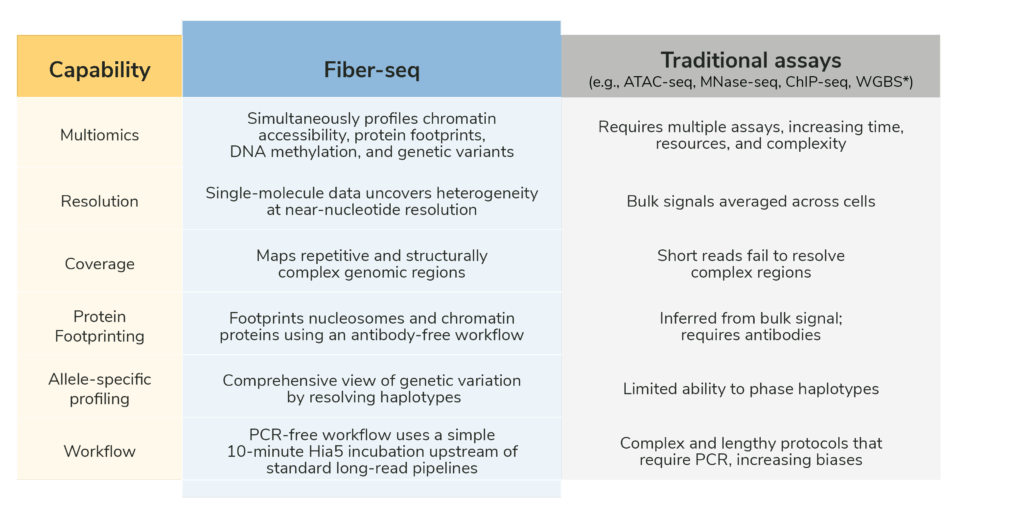
How Fiber-seq stacks against ATAC-seq, bisulfite sequencing, and ChIP-seq
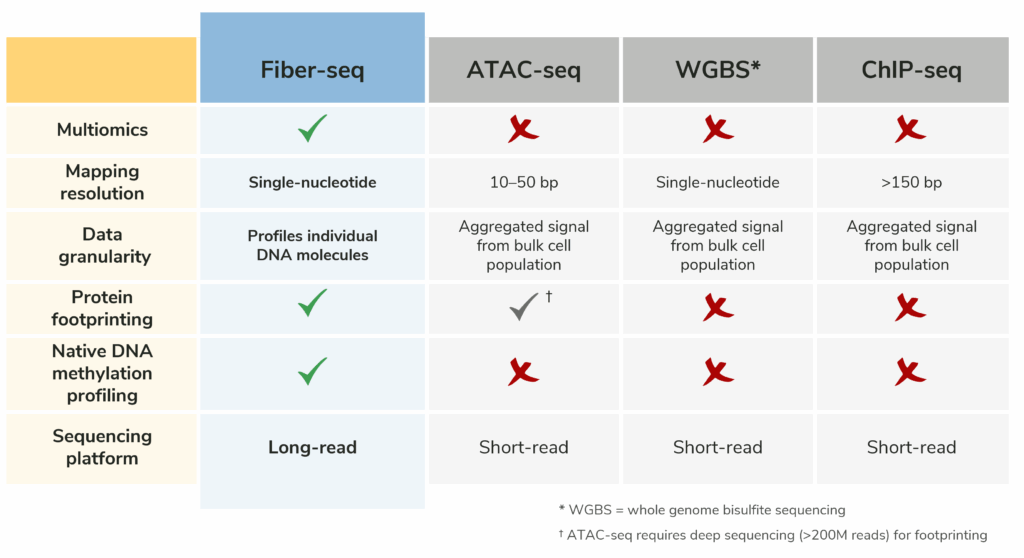
Fiber-seq: Superior multiomic insights in a single experiment
Fiber-seq streamlines epigenomic analysis by delivering data traditionally obtained from multiple assays, while enabling profiling of complex, hard-to-map genomic regions that are often missed by short-read methods.
A Simple, Scalable Workflow for Multiomic Profiling
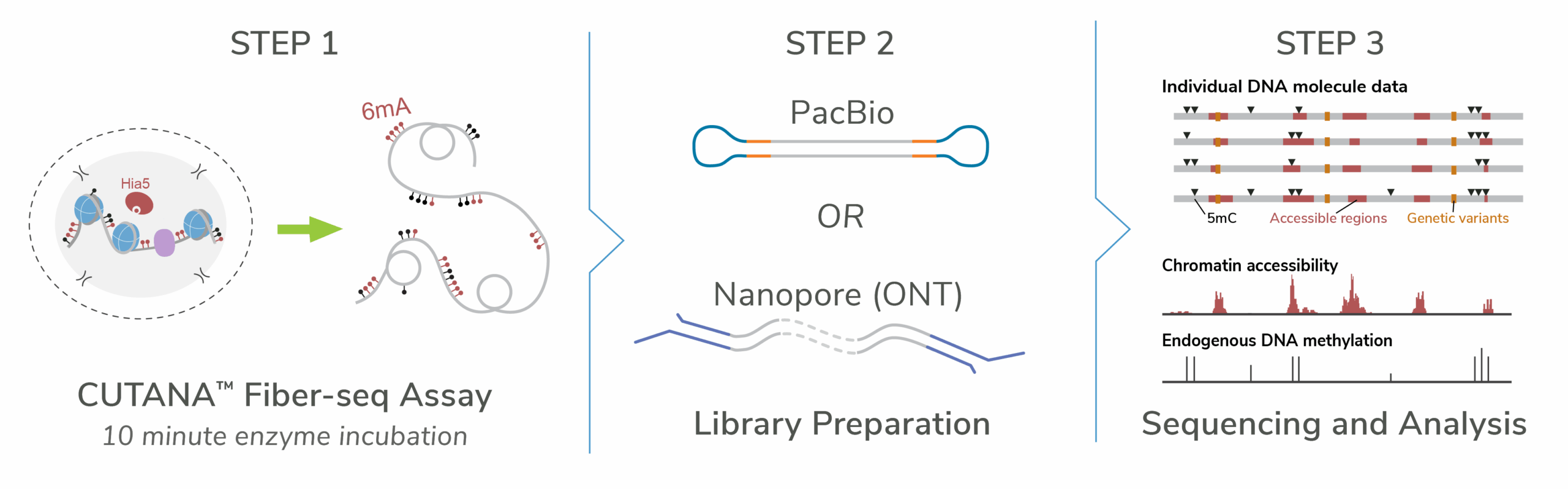
Fiber-seq uses a PCR-free, antibody-free workflow that simplifies experimental design, enabling discoveries beyond the reach of traditional short-read sequencing approaches.
The CUTANA™ Fiber-seq workflow consists of 3 easy steps:
- The Hia5 N6-methyladenine methyltransferase (6mA MTase) is added to nuclei, labeling accessible adenines with 6mA and “stenciling” chromatin accessibility directly onto the DNA.
- Genomic DNA is purified and prepared for sequencing using direct or native DNA protocols using either Pacific Biosciences® (PacBio®) HiFi or Oxford Nanopore Technologies® (ONT) sequencing platforms. These platforms detect both stenciled and endogenous DNA methylation.
- Sequencing data is analyzed to reveal multiomic information (e.g., chromatin accessibility, DNA methylation, genetic variants) at single-molecule level, which can also be aggregated for bulk analysis.
Want to get started with Fiber-seq?
EpiCypher offers several CUTANA™ Fiber-seq products to get this assay up and running in your lab.
Who is Fiber-seq for?
🌐 Researchers performing multiomic studies
Traditional multiomic projects often require performing separate assays such as ATAC-seq, ChIP-seq, and bisulfite sequencing. Fiber-seq consolidates these workflows, profiling chromatin accessibility, protein footprints, DNA methylation, and genetic variants in a single experiment — saving time and reducing complexity.
⚕️ Clinical geneticists and translational scientists
Understanding how genetic variants impact chromatin regulation is critical for disease research. Because Fiber-seq uses long-read sequencing, relationships between variants and epigenetic features are preserved across long stretches of DNA, enabling haplotype phasing. This makes Fiber-seq valuable for interpreting variants of uncertain significance (VUSs) and for investigating Mendelian disorders.
💊 Drug discovery and pharma teams
Therapeutic response is often governed by chromatin dynamics. Fiber-seq provides a comprehensive views of multiple chromatin features in a single assay, helping researchers uncover mechanisms of action, detect off-target effects, and assess the functional impact of genetic variants.
🧩 Scientists studying complex genomic regions
Short-read methods struggle to profile complex regions of telomeres, centromeres, and transposable elements. Fiber-seq resolves chromatin architecture in these difficult regions, providing new insights into genome stability and cell behavior. Such findings are especially important for fields ranging from cancer and aging to evolutionary biology.
🆕 Researchers new to epigenomics
Fiber-seq lowers the barrier to entry with a simple, PCR-free and antibody-free workflow that integrates seamlessly with existing long-read sequencing pipelines. This makes it an accessible way to explore chromatin biology without juggling multiple specialized assays.
🦎 Investigators working with emerging model organisms
In species without a high-quality reference genome, long-read sequencing enables accurate, contiguous assemblies. Fiber-seq can be directly used to generate de novo assemblies while also profiling DNA accessibility and methylation, adding layers of epigenetic information on top of new reference genomes. This opens the door to epigenomic studies in novel model species that were previously inaccessible.
Fiber-seq unravels multiple layers of chromatin regulation
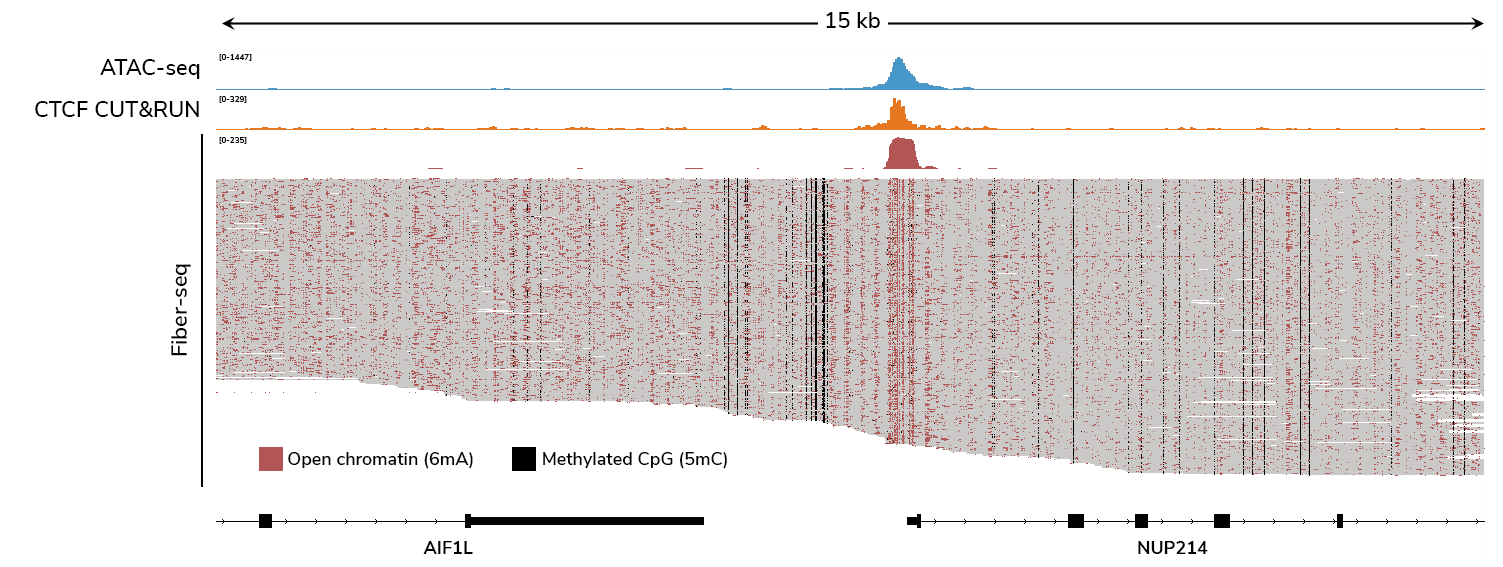
CUTANA™ Fiber-seq simultaneously detects open chromatin (marked by N6-methyladenine; 6mA) and DNA methylation (5mC) in human leukemia (K562) cells. ATAC-seq and CTCF CUT&RUN data are shown for comparison. Each horizontal line in the Fiber-seq panels represents a single long read, providing single-molecule data. Data from 60 individual DNA molecules are shown.
Fiber-seq goes beyond ATAC-seq
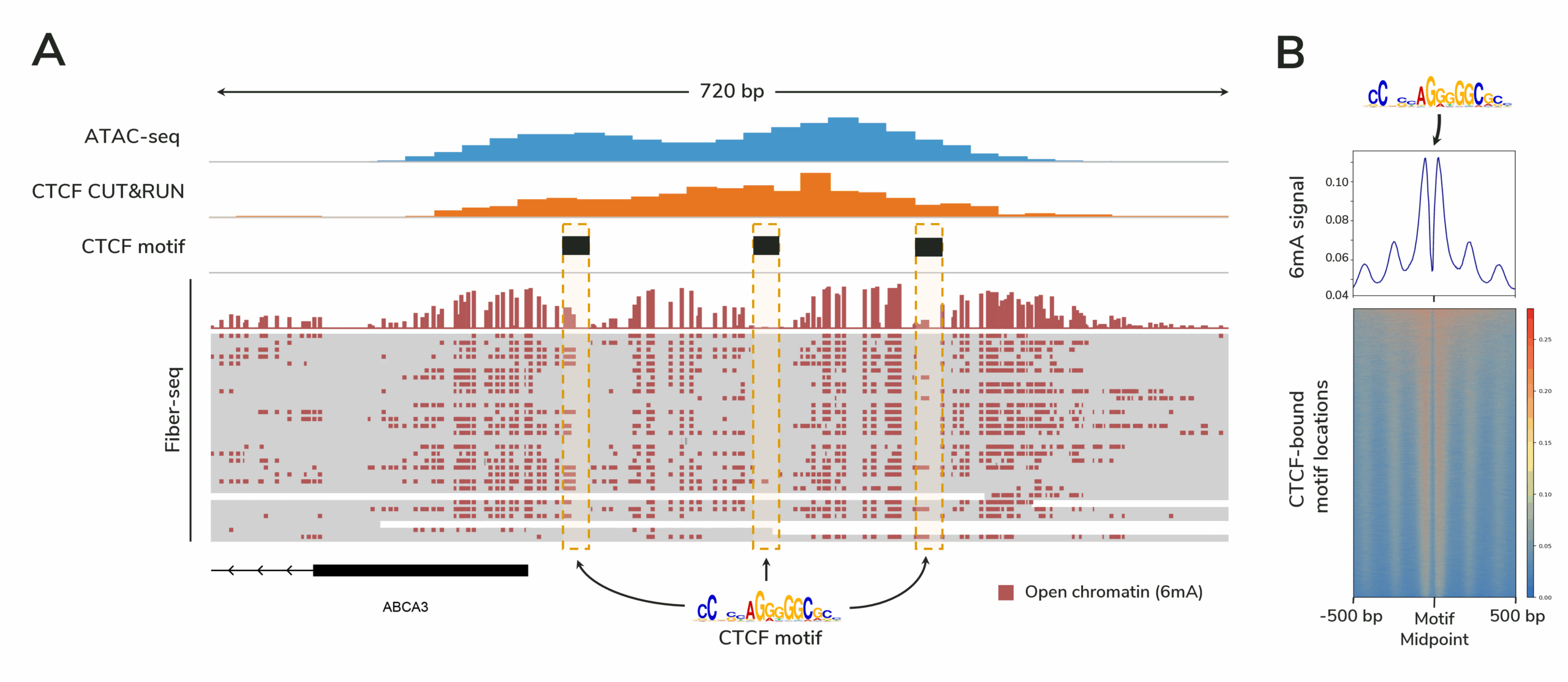
Figure Caption
(A) Fiber-seq data from 30 individual DNA molecules are shown, with the top track displaying aggregate 6mA signal marking open chromatin. Each horizontal line below this track represents a single DNA molecule. Dotted boxes indicate CTCF motif regions. Because Fiber-seq provides single-molecule resolution, heterogeneity in protein binding across the cell population is revealed (the leftmost boxed region shows variable 6mA labeling, suggesting differential CTCF occupancy).
(B) Genome-wide 6mA signal from this Fiber-seq experiment demonstrates robust footprinting of CTCF sites. Elevated 6mA levels flanking the motif midpoint reflect accessible DNA surrounding CTCF binding sites.
ATAC-seq is widely used to map open chromatin, but it has key limitations:
Requires extremely deep sequencing (>200 million reads for human genome or equivalent size) to detect transcription factor or nucleosome footprints
PCR duplicates created during library prep can obscure real signals, reducing accuracy of footprinting
Filtering duplicates biases results toward highly accessible regions
Fiber-seq overcomes these challenges by directly profiling individual DNA molecules. This provides higher-resolution footprints of transcription factors, nucleosomes, and RNA polymerase — all without the need to use antibodies. Unlike ATAC-seq, Fiber-seq does not require averaging signals across a population of cells, revealing chromatin heterogeneity that bulk methods miss.
Because Fiber-seq is PCR-free, it avoids amplification bias, simplifies experiments, and cuts bench time by half compared to ATAC-seq. And because it leverages long-read sequencing platforms, this approach also detects endogenous DNA methylation alongside accessibility and protein footprints, delivering multiple layers of information in one experiment.
Real-World Applications of Fiber-seq
⚕️ Resolve rare disease – Link genetic variants to gene regulatory changes to uncover mechanisms of Mendelian disorders (Vollger et al.)
🧠 Profile brain epigenomics – Map cell-type-specific chromatin architecture in the human brain (Peter et al.)
🛡️ Unravel complex immunology – Identify haplotype-selective chromatin accessibility in immune cells (Vollger et al.)
🧬 Track transcriptional dynamics – Monitor RNA polymerase activity and its effects on chromatin structure (Tullius et al.)
🧍🐒 Illuminate centromeres – Characterize conserved chromatin organization in repetitive centromeric regions across species (Dubocanin et al.)
🌽 Explore plant biology – Reveal hidden regulatory elements in highly repetitive crop genomes (Bubb et al.)
Get Started with CUTANA™ Fiber-seq today!
Ready to Unravel the Epigenome with Long-Read Sequencing?
Ready to Unravel the Epigenome with Long-Read Sequencing? EpiCypher offers several solutions to implement Fiber-seq:
- CUTANA™ Fiber-seq Kit: Everything you need to go from cells to library prep-ready DNA. Every kit comes with a manual packed with detailed protocols, QC recommendations, FAQs, and expert tips — plus a bench-proof QuickStart card and access to the Tech Support Center for additional guidance.
- CUTANA™ Hia5: the key enzyme required for Fiber-seq. Ideal for DIY users or those running custom workflows.
- CUTANA™ Fiber-seq Services: Prefer to have our experts run experiments for you? Explore our services for professional assay support and data delivery.
Interested in learning more about our long-read sequencing assays for epigenomics? Contact us below!